
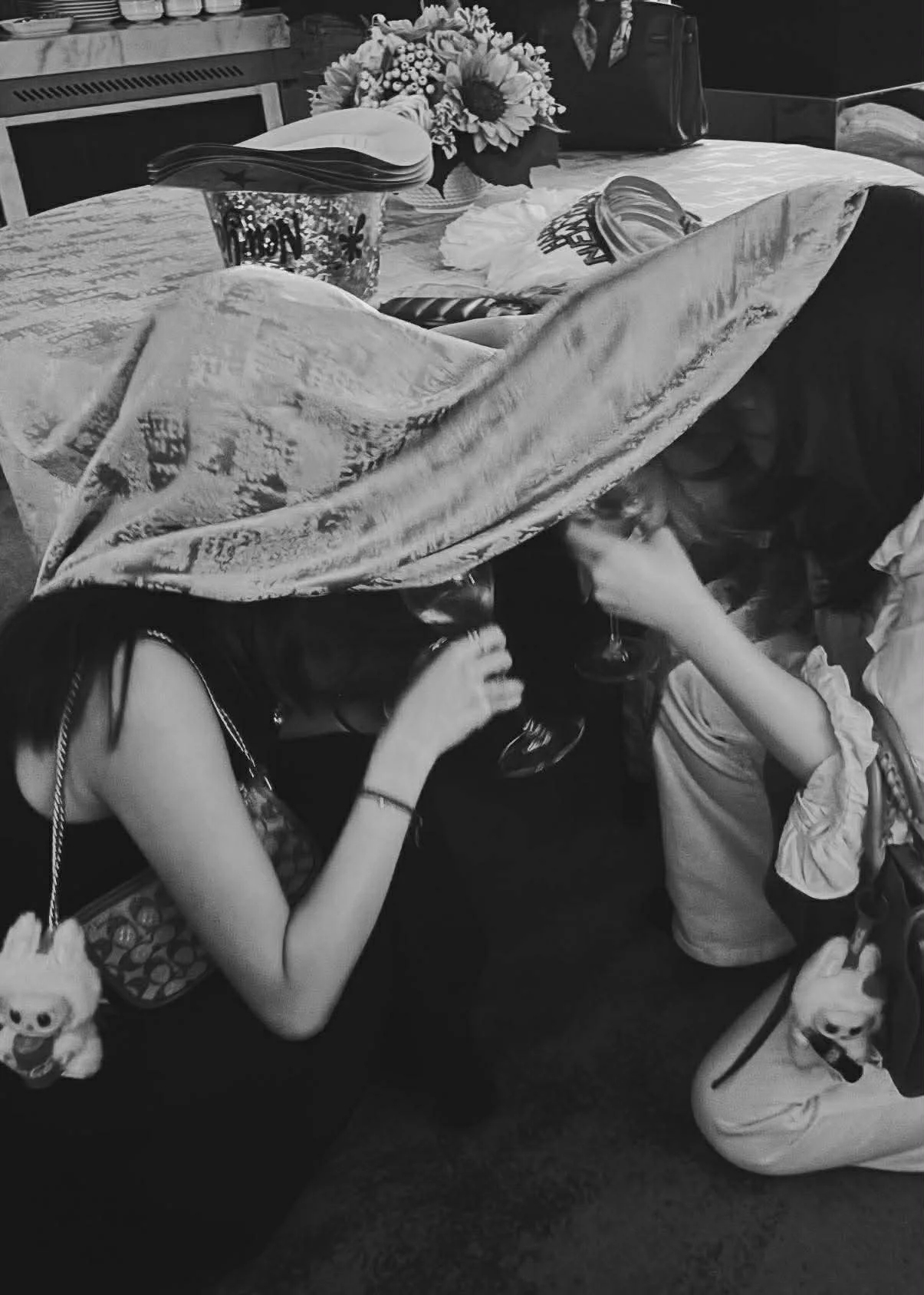
Hang on, is that your man or a Labubu?
Deconstructing British Vogue: Why Your Boyfriend May Not Be Embarrassing After All
Disclaimer: This piece was written back in November. Regrettably, Sophie has since acquired a Labubu (or two).
“Is Having A Boyfriend Embarrassing Now?”, we ask—in the same way one might Google, “Are Labubus still trending?”—as if we can’t quite fathom whether he is a bauble, a concept, or a living, breathing entity (shiver me timbers). Arguably, this deliciously unhinged question, recently viralised by British Vogue, is problematic in more ways than one—and its accompanying analysis does little to help.
Let’s first address its treatment of the word ‘boyfriend’. Posed in a vague, sweeping fashion, the question seems to assume its meaning is fixed and univocal. Surely enough, it describes a male romantic partner—but in practice, there is always something beyond this generic definition. Something unique, more personal like kindness, humour, trauma—to name but a few. Partners rarely come into our lives as prepackaged Ken dolls. They could be the love of your life, a generational mistake, the devil incarnate, or a simple mismatch. The possibilities are endless, really. To conflate boyfriends with embarrassment is not only to do injustice to the better lot, but also to understate the sheer inadequacy of others.
‘Have boyfriends become an existential embarrassment?’
‘Is singleness the new defining trait of an it-girl?’
These questions sure do spark a tantalising debate. But all the same, it’s precisely the kind of discourse that puts modern-day romance at risk. Advocacy of female independence sometimes comes at the cost of reducing love to status symbols; human connection to assets of transaction. My initial reading of the article was nothing short of a whirlwind of emotions. At first it was novelty, validation, and linguistic appreciation. But before I even knew why, everything blurred into one obtrusive question mark. I was left particularly unsettled by the idea that a woman’s ‘brand’ should be calibrated around her proximity to the man she loves; that her romantic life should tamper with her ‘cool’ factor at all. I could be mistaken, but I dare say dating and PR are quite distinct matters.
Much of the article represents a reconfigured heteronormativity—one that’s laced with faux-feminism, elegantly though subconsciously. Allow me to she-laborate: it celebrates the decentralisation of men, yet contradictorily, it also chastises what it calls the “my boyfriend-ification” of women’s social media. If men were truly decentralised, then why should anyone feel compelled to press ‘unfollow’ the moment a woman so much as implies the existence of a boyfriend? Because it’s in love’s nature to be followed by the evaporation of virtue? I think not. And to pre-empt any misunderstanding, I refer not only to extreme cases here. From the outset, it paints a scenario both pervasive and rarely acknowledged: the phenomenon of being “muted” upon ‘hard launching’ one’s relationship on the internet. Such displays of heterosexual romance are labelled pro-patriarchy by, allegedly, reinforcing male attention as social currency. We’re told that snapshots of red bouquets or the backside of a mystery man are a modern-day woman’s most Marmite way of flaunting sex appeal.
But let’s not get too distracted by the allure of critique and convolution. On the most fundamental level, was social media not created for people to share snippets of their lives? Milestones, mundanity, and the things we love? The neologism "my boyfriend-ication” becomes even more bizarre when we realise equivalent terms simply don’t exist for other subject matters. We hardly hear of expressions like “Strava-ification”, “raves-ification”, “Movember-ification” —why though? Because frankly, I’m even less interested in that six-mile run than the seven-month anniversary of a friend-of-a-friend. We hate to admit it, but our obsession with boyfriends, courtship and breakups never waned—be it our own, others’, or the lack thereof. And truthfully, this obsession often says more about the perceiver than the perceived. So perhaps the real discomfort lies not in androcentrism, but a quiet mix of envy and projection (though not to dismiss the pertinence of the former).
British Vogue, your conclusion is spot on. Today, spinsterhood dons a halo of glory that the world never saw coming; and now more than ever, women are realising that romance preserves its meaning with or without the ‘man’ (how about ‘romance’?). The problem here, however, lies in self-contradiction. Your concluding disclaimer that “there’s no shame in falling in love” does little to offset the undeniable acerbity of your infamous headline. In my opinion, to embarrass oneself isn’t to date, but to judge a woman in love by her harmless gestures of affection—because love never dwindled to a trend and most likely never will.
Truth be told, I think your boyfriend is worth a little more (or less—it really does depend) than a fuzzy, gremlin-adjacent collectible. But I’d be less confident should dating discourse sink any deeper into this rabbit hole of capitalism.